If you are looking to buy a home right now, there is likely one number dominating your thoughts: the interest rate. With national averages currently sitting in the low-to-mid 7% range, many prospective buyers are wondering if they should put their plans on hold.
It is a completely valid question. When interest rates rise, your purchasing power shrinks, making the exact same house more expensive per month than it was just a few years ago. Because of this, many buyers are choosing to “wait it out” until rates drop back down.
However, waiting carries its own hidden risks. If rates drop significantly, millions of sidelined buyers will instantly flood back into the market, triggering fierce bidding wars and driving housing prices up. By waiting for a lower rate, you might end up paying substantially more for the actual house.
So, how are smart buyers successfully purchasing homes right now without breaking their budgets?
The secret isn’t just about finding the right house—it’s about understanding the massive financing gap between buying an older “resale” home and buying new construction. Here is an educational look at how modern buyers are beating high interest rates, and the math behind the institutional incentives that make it possible.
The Problem with Resale Homes in a High-Rate Economy
When you buy a house from a standard homeowner, that seller is bound by the same economic realities you are. They cannot change the national interest rate, and they rarely have tens of thousands of dollars in cash to hand you at the closing table to help with your loan. You are entirely at the mercy of the current market.
Furthermore, in a high-rate environment, your monthly budget is tighter. If you buy a 15-year-old home and the HVAC system fails or the roof starts leaking six months after you move in, you have a major problem. Funding sudden, massive renovations usually means dipping into depleted savings or using high-interest credit cards, which compounds your financial stress.
Buying new construction changes this equation in two distinct ways: Total Cost of Ownership (warranties and energy efficiency that protect your monthly budget from surprise expenses) and Institutional Financing.
The Builder Financing Advantage
Unlike individual sellers, home builders operate as large businesses with deep financial partnerships. Builders can work with preferred lenders to purchase large blocks of money at wholesale rates—a practice known as a “forward commitment.” They can then pass those below-market rates, or significant cash credits, directly to the buyer.
Right now, builders are using these partnerships to offer two massive financial tools to buyers: Rate Locks and Closing Cost Credits.
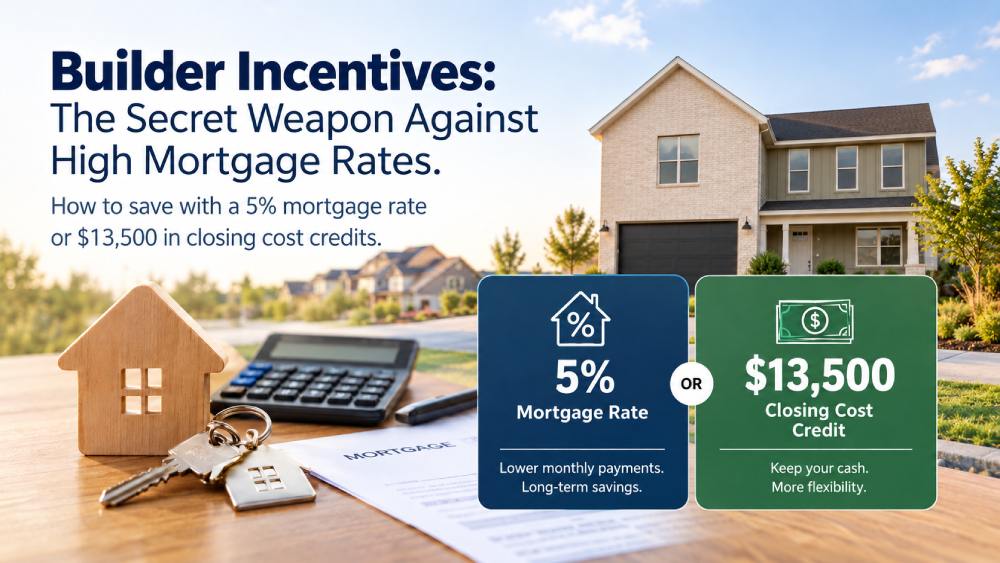
For example, our current promotion allows eligible buyers to choose between locking in a 5% interest rate or receiving $13,500 in closing costs.
Understanding the math behind both options is crucial to deciding which financial strategy is right for your family.
Strategy 1: The Below-Market Rate Lock (The Cash Flow Play)
Rather than letting buyers take whatever the current market rate is (e.g., 7.35%), the builder pays a hefty premium to the lender upfront to “buy down” the buyer’s interest rate.
The Math
Let’s look at a real-world example of purchasing a home with a $400,000 mortgage.
- The Standard Market: At a 7.35% rate, the principal and interest payment is about $2,757 per month.
- The Builder Rate Lock: With our builder-subsidized 5% rate, that exact same payment drops to roughly $2,147 per month.
The Takeaway: This strategy saves you over $600 every single month, which equates to over $7,200 a year, and tens of thousands of dollars over the life of the loan. It completely insulates you from current economic volatility, giving you the affordable monthly payment of a past housing market while allowing you to buy in today’s less-competitive environment.
Strategy 2: The Closing Cost Credit (The Liquidity Play)
As an alternative to the 5% rate lock, we currently offer buyers $13,500 in cash applied directly to closing costs. But to understand how valuable this is, you first have to understand what closing costs actually are.
What Exactly Are Closing Costs?
Buying a home requires cash. Beyond your initial down payment, you are required to pay closing costs to finalize the mortgage and legally transfer ownership of the property. Generally, these run between 2% and 5% of the total loan amount.
If you are buying a $450,000 home, your closing costs could easily range from $9,000 to $18,000. These fees typically include:
- Loan Origination Fees: What the lender charges to process, underwrite, and create your mortgage.
- Appraisal Fees: The cost to have a professional appraiser verify the home’s value for the lender.
- Title Search and Title Insurance: Fees paid to a title company to ensure there are no legal claims or liens on the property, and to insure your legal ownership.
- Prepaid Escrow Items: Lenders usually require you to pay several months of property taxes and homeowners insurance upfront to establish your escrow account.
- Recording Fees: Charges by the local government to publicly record the deed and mortgage.
When buying a standard resale home, the buyer is almost always responsible for bringing a massive check to the closing table to cover these expenses.
The Math and The Takeaway
With our promotion, you can opt to have the builder pay $13,500 of these fees on your behalf.
In an uncertain economy, maintaining liquidity—meaning cash on hand—provides massive peace of mind. Keeping $13,500 in your bank account instead of giving it to the lender gives you incredible flexibility. Some buyers prefer this option because it gives them a robust safety net for emergencies, allows them to furnish their new home without taking on expensive credit card debt, or lets them put more cash toward their down payment to build instant equity.
It is also the preferred choice for buyers who follow the popular “Date the Rate, Marry the House” philosophy. These buyers accept the standard 7% market interest rate to get into the house they love today, take the $13,500 cash from the builder to cover their fees, and simply plan to refinance their mortgage in two to three years when national interest rates eventually drop.
How to Choose Your Strategy
There is no universally “correct” choice; it depends entirely on your current financial picture and your long-term goals.
Choose the 5% Rate Lock if:
- You want the absolute lowest, most comfortable monthly payment possible.
- You plan to stay in the home long-term (7+ years).
- You want guaranteed, predictable cash flow and do not want to rely on the hope of refinancing later.
- You prefer the security of knowing exactly what your housing costs will be for the next three decades.
Choose the $13,500 Closing Cost Credit if:
- You want to preserve your personal savings and maximize the cash you have in the bank right now.
- You want to buy new furniture, install custom window treatments, or upgrade your home without using consumer debt.
- You are confident in your ability to refinance in a few years if and when market rates drop.
- You want to increase your initial down payment to build equity faster.
The Bottom Line
A 7% interest rate environment does not mean it is a bad time to buy a home—it just means the traditional way of buying a “used” home is much more expensive and risky. By understanding how to leverage institutional builder incentives, you can drastically alter the real estate math in your favor, securing a beautiful, brand-new home while protecting your financial future. If you would like to see exactly what the numbers look like for your specific situation, our team is happy to help. We can run a personalized, side-by-side comparison of the 5% rate lock versus the $13,500 cash credit on any of our available homes so you can make the most empowered financial decision possible.